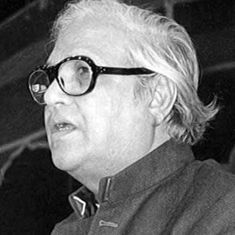
Majrooh Sultanpuri
Biography
Majrooh Sultanpuri was an Indian Urdu poet, known for his work as an Urdu poet, and as a lyricist and songwriter in the Hindi language Bollywood film industry. He was one of the dominating musical forces in Indian cinema in the 1950s and early 1960s and was an important figure in the Progressive Writers' Movement. He is considered one of the finest avant-garde Urdu poets of 20th century literature.
In his career spanning six decades, he worked with music directors, from Naushad, Madan Mohan, S.D.Burman, Roshan, Ravi, Shankar-Jaikishan, O.P.Nayyar, Usha Khanna, Laxmikant Pyarelal, Anu Malik, R.D.Burman, Rajesh Roshan, Anand-Milind and Jatin-Lalit, to Leslie Lezz Lewis and A.R.Rahman. He won the Filmfare Best Lyricist Award in 1965 for "Chahunga Main Tujhe" in film Dosti, and the highest award in Indian cinema, the Dadasaheb Phalke Award for lifetime achievement in 1993. In the 1980s and 1990s, most of his work was with Anand-Milind, their most notable collaborations being Qayamat Se Qayamat Tak, Lal Dupatta Malmal Ka, Love, Kurbaan and Dahek.
He also wrote timeless classics with Jatin-Lalit for films like Jo Jeeta Wohi Sikander (including the song Pehla Nasha) and Yaara Dildara (including the song Bin Tere Sanam), which are still heard to this day on the airwaves.
Early life
Majrooh Sultanpuri was born as Asrar ul Hasan Khan in a Muslim Rajpoot family, in Sultanpur, Uttar Pradesh, where his father was posted in the Police Department in either 1919 or 1920. His father, though, a police officer, was not too keen on his son receiving English education and Majrooh was therefore sent for traditional 'Madrasa education' which led to his obtaining the qualification first of Dars-e-Nizami - a seven-year course which concentrated on religious affairs along with proficiency in Arabic and Persian- and then the certificate of Alim. He thereafter joined Lucknow's Takmeel-ut-Tib College of Unani. He was a struggling Hakim when he happened to recite one of his ghazals at a mushaira in Sultanpur. The ghazal was a hit with the audience and Majrooh decided to drop his fledgling medical practice and began writing poetry seriously. Soon he was a 'regular' at mushairas and a "shagird" i.e. disciple of the then top name in Urdu Mushairas viz Jigar Moradabadi. While Majrooh is popular as a film lyricist and is widely known in that capacity, be it known that he also created one of the best-known verses of Urdu poetry, Main akela hee chala tha janibe manzil magar, log saath aate gaye aur carvan banta gaya! (I set off alone towards the destination but people joined in and soon it became a caravan!)
Career
In 1945, Majrooh visited Bombay to attend a mushaira at the Saboo Siddique Institute. Here his ghazals and poetry were highly appreciated by the audience. One of the impressed listeners was film producer A.R. Kardar. He contacted Jigar Moradabadi who helped him to meet Majrooh. However, Majrooh refused to write for films because he didn't think very highly of them. But Jigar Muradabadi persuaded him, saying that films would pay well and would help Majrooh to support his family. Kardar then took him to music composer Naushad who put the young writer to test. He gave Majrooh a tune and asked him to write something in the same metre, and Majrooh wrote Jab Usne Gesu Bikhraye, Badal Aaye Jhoom Ke.... Naushad liked what he wrote and Majrooh was signed on as the lyricist of the film Shah Jehan (1946). The songs of the film became so immensely popular that K.L. Saigal wanted Jab Dil Hi Toot Gaya to be played at his funeral. But before he could react to the large-scale appeal created by these lines, he fell ill. The harsh Bombay weather made him leave the city and return to his hometown in the North.